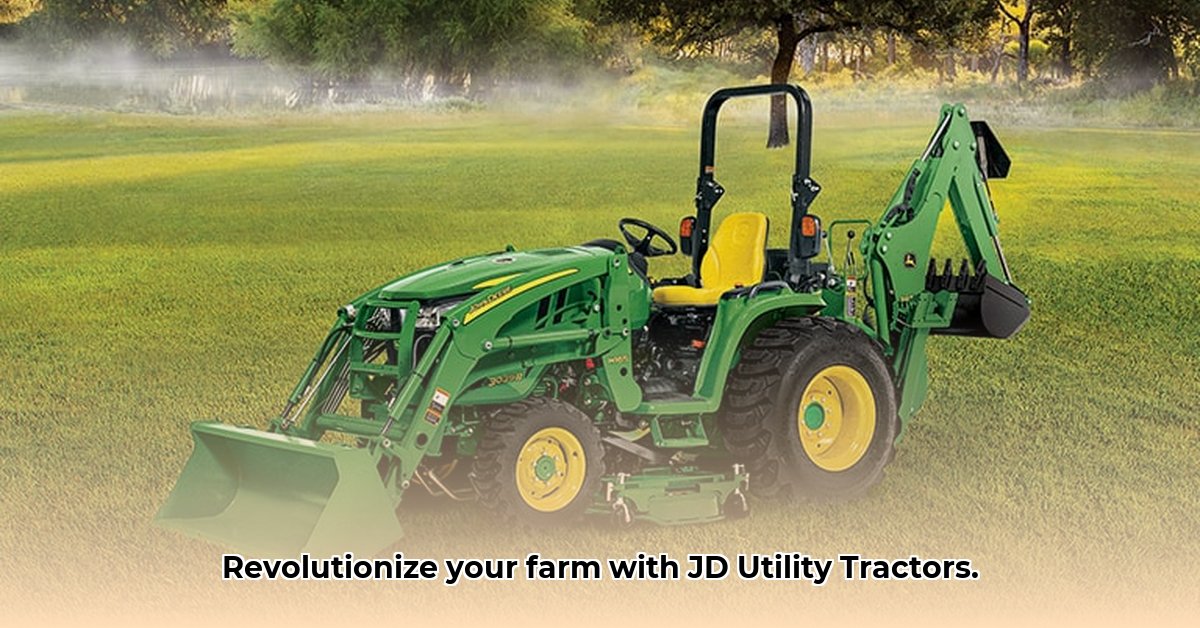
JD utility tractors are increasingly vital for farmers seeking to enhance productivity while minimizing environmental impact. Their versatility, encompassing various horsepower options, makes them suitable for diverse farm sizes and tasks—from hay baling to livestock management. This adaptability streamlines operations, reducing the need for multiple specialized machines and conserving both energy and time. The judicious selection of a JD utility tractor significantly influences a farm's profitability and its ecological footprint. For more information on JD compact utility tractors, check out this resource.
Power and Precision: Selecting the Right JD Utility Tractor
Choosing the optimal JD utility tractor hinges on several key factors. Farm size dictates the necessary horsepower; smaller farms benefit from fuel-efficient models, while larger operations necessitate more powerful machines. Workload plays a crucial role; different tractors excel in various tasks (hay, crops, livestock). Finally, budget constraints must be considered; high-end models offer advanced features, but more basic models can still provide substantial efficiency improvements over outdated equipment. A careful evaluation of these factors ensures a sustainable choice for both the farm and its financial health. How can farmers best balance their operational needs with environmental considerations when choosing a tractor?
Transmission Technologies: Optimizing Fuel Efficiency
Fuel costs represent a major agricultural expense; minimizing them is crucial for both financial success and environmental stewardship. JD utility tractors offer several transmission options, each with specific advantages. The infinitely variable transmission (IVT) (a transmission that allows for infinitely variable speeds) is prized for its precise speed control, ideal for tasks requiring fine adjustments like front-end loader operation. This reduces fuel waste from frequent acceleration and deceleration. However, IVT may not be optimal for all applications; hydrostatic or PowrQuad transmissions might be more suitable depending on individual needs. Understanding the nuances of each transmission type is vital for selecting the most fuel-efficient option. What percentage of fuel costs could realistically be reduced by choosing the most appropriate transmission for a specific application?
AutoTrac and Precision Farming: Enhancing Sustainable Practices
Precision farming technologies offer significant benefits; JD utility tractors frequently incorporate advanced features like AutoTrac (an automated steering system). This system minimizes overlapping passes during fieldwork, resulting in substantial fuel savings – accurately guiding the tractor along pre-planned paths. The resultant time savings translates to increased acreage coverage per day. AutoTrac’s benefits extend beyond financial gains; it’s a key component of environmental sustainability. While advanced features like AutoTrac can be expensive, even simpler precision technology often provides substantial returns on investment in terms of productivity and resource conservation. What is the potential return on investment for a farmer who implements AutoTrac technology, considering both reduced fuel costs and increased acreage coverage?
Assessing the Broader Environmental Impact: Beyond Horsepower and Fuel
A comprehensive sustainability assessment of a JD utility tractor extends beyond fuel efficiency and horsepower. Ideally, independent data on fuel consumption (liters/hectare or gallons/acre) and greenhouse gas emissions (gCO2e/unit of work) should be readily available for all models. This data is critical for comparing tractors across manufacturers and models. The manufacturing process itself, including material sourcing and production energy, must also be considered. Long-term durability and the ease of repair or part replacement are often overlooked but significantly impact overall environmental sustainability. The current lack of comprehensive data hinders informed, environmentally responsible decision-making. Dr. Emily Carter, Professor of Chemical and Biological Engineering at Princeton University, highlights the need for more transparent lifecycle assessments in agricultural machinery.
Actionable Steps for Sustainable Farming with Your JD Utility Tractor
Farmers can take several practical steps to enhance the sustainability of their operations:
- Transmission Optimization: Thoroughly research the fuel efficiency of different transmissions and select the one best-suited for your workload.
- Precision Technology Adoption: Implement an automated steering system like AutoTrac to significantly reduce fuel consumption and time waste, if budget allows.
- Lifecycle Cost Analysis: Consider long-term costs (maintenance, repairs, parts, fuel) to achieve both economic and environmental sustainability.
- Alternative Fuel Exploration: Investigate alternative or biofuels to lower your carbon footprint, ensuring compatibility with your tractor model.
- Advocacy for Data Transparency: Encourage manufacturers to publicly release comprehensive sustainability data for their tractor models.
The Future of Sustainable Agriculture: A Collaborative Effort
Building a truly sustainable agricultural future requires collaboration. Farmers require access to transparent and reliable sustainability data for informed purchasing decisions. Manufacturers like John Deere must invest in sustainable manufacturing processes and provide life-cycle impact information on their products. Government agencies can incentivize fuel-efficient technologies through subsidies or tax breaks and introduce stricter emission regulations. Sustainable agriculture demands a partnership that balances productivity and environmental responsibility; we all have a crucial role to play.
How to Calculate the Lifecycle Carbon Footprint of John Deere Tractors
Key Takeaways:
- Data integration platforms, while promising, require improved data accuracy and standardization for effective sustainability assessment.
- Precision agriculture technologies offer considerable potential for reducing a farm's environmental footprint.
- Calculating the lifecycle carbon footprint of John Deere tractors is a multi-faceted process, including manufacturing, operation, and end-of-life considerations.
- Standardized metrics and transparent data sharing are vital for accurate assessment and comparison.
- A collaborative effort from farmers, retailers, technology providers, and governments is essential to support sustainable practices.
Calculating a John Deere tractor's carbon footprint requires a comprehensive lifecycle assessment (LCA). This includes:
- Manufacturing: Material extraction, manufacturing processes, transport to dealerships, and delivery to farms all contribute to the carbon footprint – requiring data on energy use and emissions at each stage.
- Operational Phase: Fuel consumption is key; tractor efficiency (e.g., IVT transmission), fuel type (biodiesel vs. conventional diesel), operational hours, and the use of features like AutoTrac all impact the total fuel burn.
- End-of-Life: Disposal methods (scrap, recycle, repurpose) greatly affect environmental impact; recycling reduces the need for new materials, lowering emissions.
Data collection for accurate calculations is crucial: detailed manufacturing data from John Deere (or other manufacturers), meticulous operational data (fuel consumption, hours of operation, use of additional features) from farmers, and end-of-life data (recycling methods or scrapping) are all necessary. This data, analyzed using established LCA methodologies, provides the total greenhouse gas (GHG) emissions associated with each lifecycle stage. Challenges remain: consistent, comprehensive data availability and standardized metrics are crucial for accurate comparisons. Future improvements will focus on better data collection and analysis tools, including automated data tracking from tractors and increased supply chain transparency.